
Capital in the real estate market remains abundant, but it is no longer driven by a speculative mindset. Instead, it prioritizes products with real commercial potential tied to long-term growth drivers, according to experts.
Speaking at a recent seminar on the real estate market for the second half of the year, Mr. Ngo Thanh Huan, CEO of FIDT, stated that the economy's liquidity foundation remains vast, indicating that cash flow has not decreased at all.
According to him, residential deposits have surpassed VND 10.5 quadrillion, and credit growth across the economy continues to rise, potentially reaching 17–18% this year, higher than the regulatory target of around 15%. Meanwhile, the stock market maintains a market capitalization equivalent to about 80% of GDP, and the bond market continues to expand.
"There is no shortage of money in the real estate market; what has changed is how the cash flow moves," Mr. Huan emphasized.
He further analyzed that the market has entered a restructuring phase that is more selective, rather than experiencing uniform growth as before. This shift is most clearly reflected in investor behavior. While they used to look for areas about to receive zoning updates or road expansions to buy land, their selection criteria are now more practical, focusing on the ability to generate cash flow.
"Investors are now concerned with whether an area has industrial parks, whether it creates jobs, and how the property can be rented out to generate cash flow," he said. This shift shows that money is moving away from purely speculative trends toward assets with completed infrastructure, clear legal status, and practical utility.
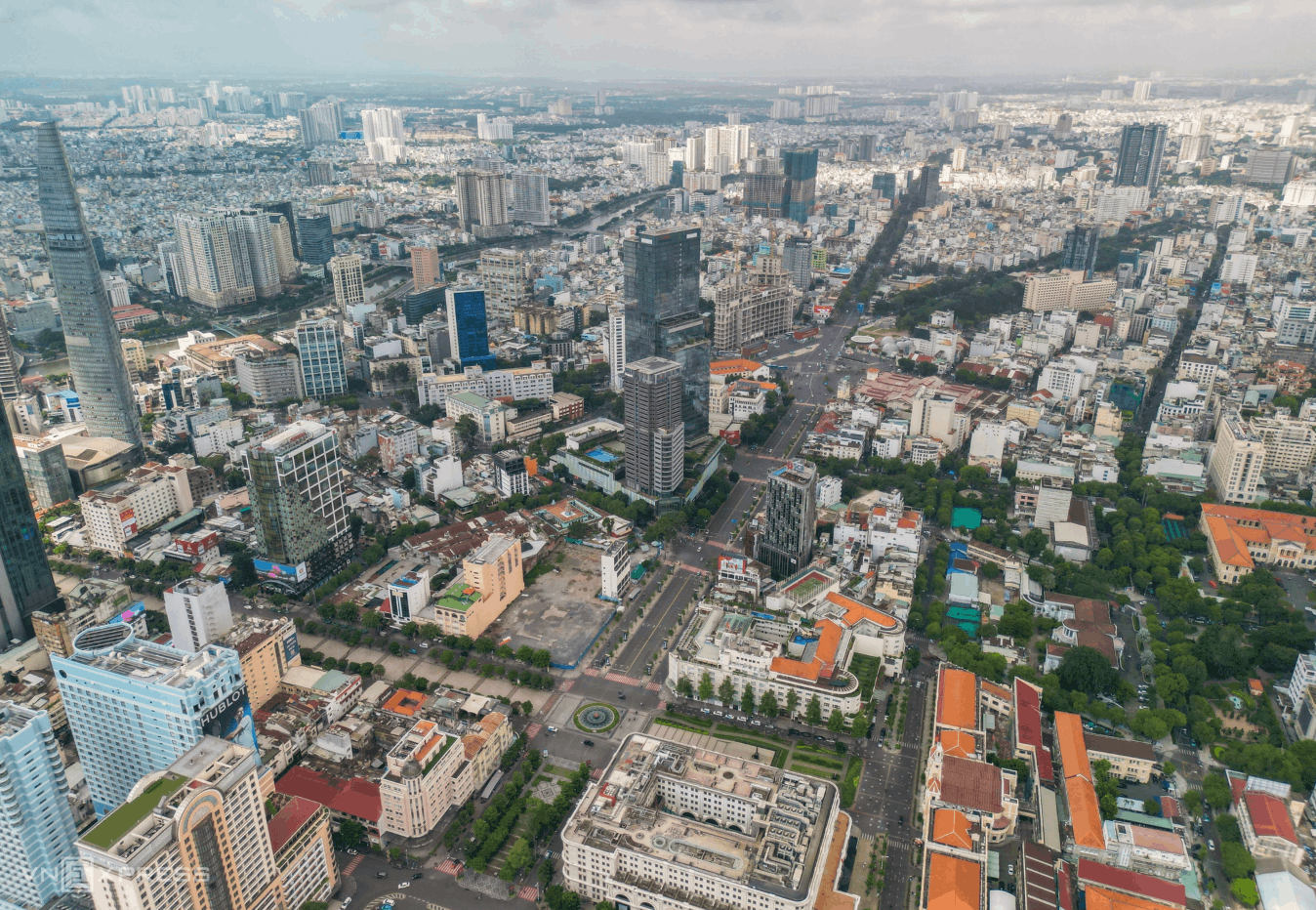
A corner of the real estate market in downtown Ho Chi Minh City. Photo: Quynh Tran
This change is vividly reflected in the supply-demand dynamics of the real estate market in the first half of this year. Data from the Vietnam Association of Realtors (VARS) shows that the scale of property transactions remains large. In 2025, the market recorded over 150,000 new real estate products and more than 100,000 successful transactions.
In the first half of this year, around 60,000 products were launched into the market with 35,000 transactions, corresponding to an absorption rate of about 58%. According to VARS, although the absorption rate has decreased compared to the previous period, the transaction volume of tens of thousands of products proves that cash flow is still circulating, albeit more concentrated on certain asset classes.
A survey by OneHousing also indicates that the demand for purchasing real estate remains significant, with 41% of respondents stating they plan to buy within the next 6 to 12 months. This figure reflects that a large amount of capital has not left the market but is waiting in anticipation of the right opportunity to disburse rather than being withdrawn completely.
From a market perspective, the absorption structure also clearly reflects this trend. Ms. Do Thi Huong, Director of Residential Sales at Savills Vietnam, cited data showing that in Hanoi, about 80% of transactions were concentrated in Grade B and C apartments (mid-end and affordable segments), while luxury apartments accounted for a lower proportion.
In Ho Chi Minh City, over 90% of the absorption also belonged to Grade B and C apartments, while Grade A apartments only accounted for a small fraction. "This indicates that cash flow is prioritizing affordable products that serve real housing needs and are easy to operate, rather than focusing on highly speculative products," Ms. Huong assessed.
Mr. Tran Quang Trung, Business Development Director at OneHousing, noted that the real estate market in the second half of the year is entering a phase of mega-projects and intense restructuring.
According to him, while previously just having a land bank was enough to develop a project, today factors such as financial capacity, execution capability, cash flow management, and customer insight are the decisive factors.
He also observed that buyer behavior is shifting noticeably. Instead of asking "how far," customers now ask "how long it takes to get there" when evaluating real estate. This makes areas connected to infrastructure like metros, ring roads, or inter-regional routes more attractive, especially satellite cities.
From a macro perspective, Dr. Nguyen Van Dinh, Chairman of the Vietnam Association of Realtors, stated that real estate demand is no longer as uncritical as before but is now focused on assets with transparent legal status, reasonable costs, and good commercial value. Among these, apartments continue to be the segment driving liquidity, while synchronized low-rise urban areas maintain their appeal. Conversely, products heavily reliant on price appreciation expectations or lacking a resident base still struggle to attract cash flow.
Sharing this view, Mr. Ngo Thanh Huan said that the new growth engine of real estate is closely linked to the industrialization process and FDI inflows. As enterprises expand production in Vietnam, labor demand increases, leading to mechanical population growth and housing demand in neighboring areas.
Localities with a strong industrial base like Bac Ninh, Binh Duong, or Hai Phong are recording more stable commercial performance, supported by rental cash flows and real housing needs. "Areas with growing mechanical population growth will generate real demand and create a foundation for sustainable growth," he emphasized.
Overall, experts believe that the real estate market is transitioning from a phase of "overheating driven by expectations" to "selective growth," where capital is not leaving the market but is being reallocated into assets with good utility and commercial value, tied to infrastructure development.
Consequently, the trend of short-term, speculative "flipping" is projected to continue declining, making way for long-term holding strategies and cash flow exploitation, which are better suited to the market's new development cycle.
__________
Source: VNExpress - 29/6/2026, 08:47